ICAI Advertising & Website Rules for CA Firms (2026): What the Code of Ethics Actually Allows
The short answer: From 1 April 2026, ICAI’s Code of Ethics lets CA firms advertise through a factual “write-up” in print, online, and on social media, and actively promote non-exclusive services such as accounting and consultancy. Audit and attestation can only be shown to people who look for them. Testimonials, fee displays, slogans, and firm logos remain prohibited.
Key facts:
- In force date: 1 April 2026 (Code of Ethics 2026, Vol. I, p. 222). Exception: Management Consultancy item (xxxi) on Social/CSR Impact Assessment came into force on 11 December 2025 (cl. 2.2.3, p. 18; p. 222).
- Primary source: Code of Ethics, 2026 (13th Edition), Volume I, Chapter 3: “Council Guidelines for Advertisement, 2008 (Updated up to December, 2025)”, pages 148–158.
- Council approval: ICAI’s press release of 12 December 2025 reported that the Council approved the changes at its 447th meeting.
- Who it applies to: members in practice, firms of Chartered Accountants, and networks/alliances of firms registered with ICAI (cl. 3.1, p. 148; cl. 3.3.1, p. 152).
Why this matters: if your website was built before April 2026, it may say less than the Code now allows, or use wording it still doesn’t allow, such as slogans, logos, testimonials, or fee tables. ICAI doesn’t pre-approve write-ups (cl. 3.1.1, p. 148), so the responsibility sits with your partners.
1. What changed on 1 April 2026
CA firms have been allowed to advertise through a factual “write-up” since the Council Guidelines for Advertisement, 2008. What the 2026 Code changes is how far that write-up can go online. ICAI’s press release of 12 December 2025 names three changes:
| What changed | From 1 April 2026 | Source |
|---|---|---|
| Scope of the write-up | The write-up covers print and electronic media, including websites and “social Networking Websites (in Push as well as in Pull mode)”. | Code of Ethics 2026, cl. 3.1.2(iii), pp. 148–149 |
| Push technology on websites | Websites “may run on ‘Pull’ as well as ‘Push’ technology”. Services exclusively reserved for CAs stay pull-only. | cl. 3.3.3, p. 153 |
| Network firm websites | Networks and alliances of firms registered with ICAI may have their own websites. | cl. 3.3.1, 3.3.6, pp. 152–153 |
The Code also lists some website details that matter in practice, such as Peer Review status, AQMM level, and the regulator-required fee disclosure. These are covered in the website section below.
The press release put it this way:
“The updated Guidelines on Advertisements and Websites will enhance accessibility, improve professional visibility, and align with contemporary global practices. The revisions in the scope of ‘write-up’ of advertisement and other revisions will give greater creative flexibility to members. These revisions collectively enable Chartered Accountants to present their professional services in a more effective and modern manner. In the website guidelines, the Council has proposed greater flexibility by allowing members and firms to use push technology for services that are not exclusive to the CA profession (e.g., consultancy, accounting, etc.). Allowing such non-exclusive services to be promoted through “push mode” enhances visibility, aligns with current digital practices, and provides a level playing field for Chartered Accountants. Further, network firms registered with ICAI will now be permitted to develop and maintain their own websites.“
— ICAI Press Release, 12 December 2025
2. Push vs. pull technology, explained
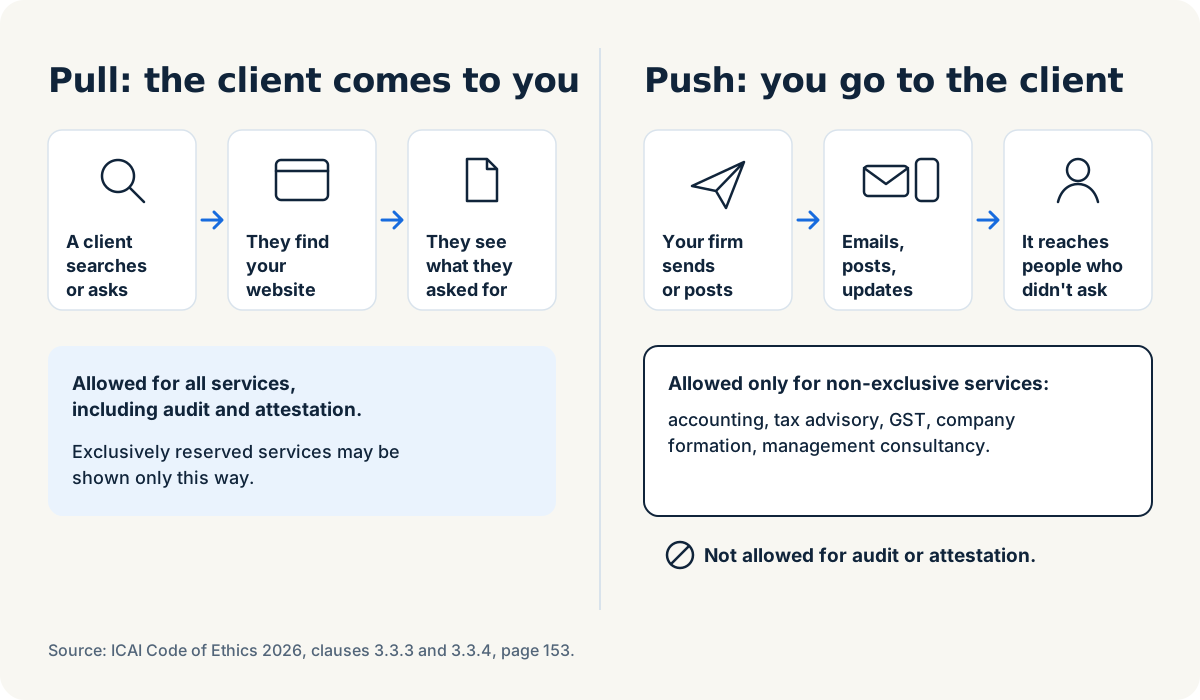
The 2026 website rules turn on the difference between “Push” and “Pull” technology (Code of Ethics 2026, cl. 3.3.3, p. 153).
- Pull technology: Information is retrieved only when an individual user actively seeks it out. For example, a prospective client searching Google for a corporate auditor and landing on your website, or submitting a specific enquiry for your credentials.
- Push technology: Information is delivered proactively to recipients without a prior specific request for that material. For example, email newsletters sent to subscribers, social media posts appearing in user feeds, or automated updates.
The governing clauses: 3.3.3 and 3.3.4
Clause 3.3.3 sets the rule:
“The websites of Chartered Accountants and/or Chartered Accountants’ Firms or Network/Alliance of firms registered with ICAI may run on “Pull” as well as “Push” technology. For services which are exclusively reserved for Chartered Accountants, only “pull” model will be permitted to ensure that any person who wishes to locate the exclusive services of Chartered Accountants or Chartered Accountants’ firms would only have access to the information and the information should be provided only on the basis of specific “pull” request.“
— Code of Ethics 2026, cl. 3.3.3, p. 153
Under Clause 3.3.4, firms must ensure that:
“none of the information pertaining to services which are exclusively reserved for Chartered Accountants contained in the Website be circulated on their own or through E-mail or by any other mode or technique except on a specific “pull” request.“
— Code of Ethics 2026, cl. 3.3.4, p. 153
Which services are “exclusively reserved”?
Under Clause 2.14.1.6(iv)C(3) (p. 55) and Appendix K (p. 215), the Council defines exclusively reserved services as:
“services which are exclusively reserved for Chartered Accountants by statute viz. Audit and Attestation Services such as Audit under Companies Act 2013, Income Tax Act 1961, etc.”
— Code of Ethics 2026, cl. 2.14.1.6(iv)C(3), p. 55
The Code doesn’t publish a full list. In practice, a service that the law also lets other professionals perform (advocates, Company Secretaries, Cost Accountants, tax or GST practitioners) is non-exclusive. The Code’s list of “Management Consultancy and other Services” is non-exclusive by definition (cl. 2.2.3, pp. 15–18).
Exclusive vs. non-exclusive services
Our reading: The table below applies the Code’s definition to the statutes named. Confirm any borderline service for your firm.
| Service | Classification | Allowed | Clause |
|---|---|---|---|
| Statutory Company Audit | Exclusively Reserved (Companies Act 2013, s. 139 & 141) | Pull Only | cl. 3.3.3, p. 153; cl. 2.14.1.6(iv)C(3), p. 55 |
| Tax Audit (Section 44AB) | Exclusively Reserved (Income-tax Act 1961, s. 44AB) | Pull Only | cl. 3.3.3, p. 153; cl. 2.14.1.6(iv)C(3), p. 55 |
| Statutory Attestations & Certifications | Exclusively Reserved (Statutory CA certificates) | Pull Only | cl. 3.3.3, p. 153; cl. 2.14.1.6(iv)C(3), p. 55 |
| LLP Statutory Audit | Exclusively Reserved (LLP Act 2008, s. 34(4)) | Pull Only | cl. 3.3.3, p. 153; cl. 2.14.1.6(iv)C(3), p. 55 |
| Accounting & Bookkeeping | Non-Exclusive (Open to all accountants) | Push and Pull | cl. 3.3.3, p. 153; ICAI Press Release 12-12-2025 |
| Income Tax Return (ITR) Filing | Non-Exclusive (Open to tax practitioners, advocates) | Push and Pull | cl. 3.3.3, p. 153 |
| Tax Advisory & Planning | Non-Exclusive (Open to legal and financial advisors) | Push and Pull | cl. 3.3.3, p. 153 |
| Tax Representation (Section 288) | Non-Exclusive (Open to advocates, authorised reps) | Push and Pull | cl. 3.3.3, p. 153; Income-tax Act s. 288 |
| GST Registration, Filing & Appeals | Non-Exclusive (Open to GST Practitioners, advocates) | Push and Pull | cl. 3.3.3, p. 153; CGST Act s. 48 |
| Company Formation & ROC Filings | Non-Exclusive (Open to CAs, CS, CMA, Advocates) | Push and Pull | cl. 3.3.3, p. 153 |
| Management Consultancy (32 areas) | Non-Exclusive (Section 2(2)(iv) list) | Push and Pull | cl. 2.2.3, pp. 15–18; cl. 3.3.3, p. 153 |
Cautious approach for your website: On your firm website, separate non-exclusive services from statutory audit. Non-exclusive services (tax advisory, bookkeeping, management consultancy) may be showcased openly. For statutory audit and tax audit, display factual descriptions only and make detailed credentials accessible upon specific user request or enquiry (cl. 3.3.3, p. 153).
3. What you can say: the write-up rules
Under Clause 3.1 (p. 148), members may advertise through a write-up: a factual statement of their own particulars, their firm’s particulars, and the services they provide. Under Clause 3.1.2(iii) (pp. 148–149), a write-up covers print, newspapers, journals, directories, magazines, websites, and social networking websites in push as well as pull mode.
The nine conditions every write-up must meet (clause 3.1.3 A–I)
Under Clause 3.1.3 (pp. 149–150), every write-up must comply with nine conditions:
- Honest: It shall be honest and truthful (Condition A).
- No exaggerated claims: No exaggerated claims about services offered, qualifications, or experience (Condition B).
- No comparisons: No disparaging references to, or unsubstantiated comparisons with, the work of others (Condition C).
- Dignified: Nothing that may bring the profession into disrepute (Condition D).
- No testimonials: No testimonials or endorsements concerning the member or the fees charged (Condition E).
- No private awards: No achievements or awards, except awards given by Central or State Governments or regulatory bodies (Condition F).
- No monograms or catch words: No monogram of any kind and no catch words (Condition G).
- No event photographs, with one social media exception: Event photographs aren’t allowed. Photos on social networking sites from cultural programmes or festivals organised by the firm are, provided there is no element of advertisement or solicitation (Condition H).
- Within the law: Nothing that breaches the CA Act 1949, the CA Regulations 1988, the Code of Ethics 2026, or Council guidelines (Condition I).
What a write-up may include (clause 3.2.1)
Clause 3.2.1 (pp. 150–152) specifies what a write-up may include:
- For Members (3.2.1(A)): Name (with prefix “CA”), Membership Number, age, date of ACA/FCA, date from which COP is held, recognised qualifications, languages known, contact numbers, professional address, website, email, CA India Logo, passport-style photograph, staff numbers by category, services provided, directorship in an ICAI-registered MCS company, and name of client and nature of assignment handled, subject to permission of the client (for exclusive services, client name only) (cl. 3.2.1(A), pp. 150–151).
- For Firms (3.2.1(B)): Firm name (with “Chartered Accountants”), Firm Registration Number (FRN), year of establishment, registered addresses, working hours, contacts, partner details and photos, CA India Logo, website, employee details, services provided, registered network affiliation, and name of client and nature of assignment handled, subject to permission of the client (for exclusive services, client name only) (cl. 3.2.1(B), pp. 151–152).
Practical tip on client permission: The Code requires “permission of the client” without specifying written form (cl. 3.2.1(B)(xvi), p. 152). In practice, get the permission in writing (via email or engagement letter confirmation) so you can show it immediately if asked by the Institute.
4. What your website may show: the clause 3.3 checklist
Clause 3.3 (pp. 152–157) sets out what a CA firm website may and may not do. Use this table to check each part of your site.
Clause-by-clause website checklist
| Clause and area | What the Code says | What to do on your website |
|---|---|---|
| 3.3.1–3.3.2 Format | CAs, firms, and registered network/alliance firms are free to create websites; no standard format prescribed (pp. 152–153). | Custom, mobile-responsive layout permitted; must remain dignified. |
| 3.3.3 Push/Pull | Push and pull technology allowed; exclusive services restricted to pull model (p. 153). | Non-exclusive services visible; audit accessible via user pull. |
| 3.3.4 Audit Push | Exclusive services info must not be circulated unrequested by email or any mode (p. 153). | Do not send unrequested audit brochures via email broadcasts. |
| 3.3.5 Visit Solicitation | Cannot issue circulars or ads soliciting website visits. URL permitted on stationery and email (p. 153). | Print URL on business cards and email signatures; no cold “visit our site” flyers. |
| 3.3.6 Network Info | Registered networks may display Registration Number and networking model (p. 153). | Display network name, registration number, and model in footer. |
| 3.3.7(i)–(iii) Particulars | Permitted: Firm name, year of establishment, addresses, phone, fax, email (pp. 153–154). | Standard header/footer contact block matching ICAI portal records. |
| 3.3.7(iv)–(v) Quality | Permitted: Peer Review status and AQMM level reviewed by an AQMM reviewer (p. 154). | Factual text: “Peer Reviewed Firm (Valid up to 2027)” and “AQMM Level: Level 2”. |
| 3.3.7(vi)–(vii) Services | Permitted: Nature of services. Exclusive services displayable only on specific pull request (p. 154). | Factual service descriptions; separate attestation from general advisory. |
| 3.3.7(viii)–(ix) Team | Permitted: Partner names, qualifications, qualification year, direct contacts, experience area, staff details (p. 154). | Partner profiles with factual CV data, qualifications, and experience areas. |
| 3.3.7(x)–(xii) Careers | Permitted: Job vacancies (including articleship), number of articles, network affiliation (p. 154). | Dedicated “Careers / Articleship” page with application criteria. |
| 3.3.7(xiii) Clients & Fees | Permitted: Client name and assignment nature with client permission (exclusive services: client name only). Fee charged cannot be given (p. 154). | Text list of client names with permission on file. Never publish fees. |
| 3.3.7 Proviso Fee Exception | Fees permitted only where required by a domestic or foreign regulator, with mandatory italicised disclosure below (pp. 154–155). | Never show pricing tables. If disclosing regulator-required fees, include exact italicised note. |
| 3.3.8 Network Updates | Network sites must update partner changes; no mentioning entities outside network (p. 155). | Keep network listings in sync with official ICAI notifications. |
| 3.3.9 Photos & Galleries | Permitted: Passport-style photos; photo galleries of firm-organised professional events or partner lectures (p. 155). | Professional headshots; gallery from technical seminars or workshops. |
| 3.3.10 Knowledge Content | Permitted: Blogs, articles, professional information, bulletin boards, updates, educational videos (p. 155). | Knowledge section with tax deadline calendars and technical updates. |
| 3.3.11 Portals & Chat | Permitted: Secure client chat and document management facility with password log-in (p. 155). | Secure client portal login button for exchanging tax documents. |
| 3.3.12 Social Media Links | Permitted: Links to social pages. Forbidden: Soliciting visitors to visit or like the pages (p. 156). | Add plain social icons; do not write “Click here to like our page”. |
| 3.3.13 Online Advice | Permitted: Providing online advice to clients who specifically request it, free or on payment (p. 156). | Secure consultation request form for specific enquiries. |
| 3.3.14 Anti-Solicitation | Website must not solicit clients; breaches can lead to disciplinary action suo motu or on complaint (p. 156). | Our reading: avoid pop-ups, urgency banners, and “leave your number” forms aimed at prospects. |
| 3.3.15 Confidentiality | Website must ensure adequate secrecy of client matters handled through it (p. 156). | SSL encryption, secure hosting, and password-protected portals. |
| 3.3.16 Banner Ads | No advertisement in the nature of a banner or any other nature permitted on the website (p. 156). | Do not host third-party commercial banners or ad networks on your site. |
| 3.3.17 Dignity | Website must be befitting the profession and contain nothing unbecoming of a CA (p. 156). | Maintain clean, conservative typography, layout, and visual presentation. |
| 3.3.18 External Links | Permitted: Links to ICAI, Regional Councils, branches, government departments, and regulators (p. 156). | Helpful links to Income Tax Portal, MCA21, GST Portal, and ICAI.org. |
| 3.3.19 Elected Offices | Permitted: Mentioning existing or past elected positions held in ICAI (Central/Regional Council, Branches) (p. 156). | Partner bio note: “Past Chairman, Bengaluru Branch of SIRC of ICAI (2021–2022)”. |
| 3.3.20 Domain Name | Address must be as near as possible to individual name, trade name, or firm name registered with ICAI (pp. 156–157). | Use firmname.com or firmname.in; never use generic keywords like bestbangaloreca.com. |
| 3.3.21 ICAI Records Match | Information displayed must not be at material variance from ICAI records (p. 157). | Partner lists, office addresses, and branch counts must match your records on ICAI’s Self-Service Portal (SSP). |
5. Logos, names, and branding
Firm logos and monograms are prohibited
Clause 2.14.1.7(xvii) (p. 67) records the Council decision:
“the use of logo/monogram of any kind/form/ style/design/colour etc. whatsoever on any display material or media e.g. paper stationery, documents, visiting cards, magnetic devices, internet, sign board, by the members in practice and/or the firm of Chartered Accountants, be prohibited. Use/printing of member/firm name in any other manner tantamounting to logo/monogram was also prohibited.”
— Code of Ethics 2026, cl. 2.14.1.7(xvii), p. 67
CA firms cannot design an emblem, crest, or brand mark, nor print the firm name in a stylised, logo-like typography on any medium, including websites.
The CA India logo is permitted
Under Clause 2.14.1.7(xviii) (p. 68), the Council recognises the unique CA India Logo issued in 2023. The Code describes it as:
“letters ‘CA’ in blue colour with a tri colour tick mark (upside down) with white background”
— Code of Ethics 2026, cl. 2.14.1.7(xviii), p. 68
Under the same clause, the Council has decided that use of the CA logo in the stamp is permissible, subject to CA logo guidelines. Use the logo only as set out in ICAI’s CA India logo guidelines (Appendix L of the Code, pp. 216–221).
Professional designations
- Clause (7) bars any designation other than “Chartered Accountant” on professional documents, visiting cards, letterheads, and signboards, apart from recognised degrees and memberships (cl. 2.14.1.7, p. 61). The Code gives examples: it is improper to describe yourself as an “Income-tax Consultant, Cost Accountant, Company Secretary, Cost Consultant or a Management Consultant” (cl. 2.14.1.7(ii), p. 61).
- Individual members in practice may use the prefix “CA” before their name (cl. 2.14.1.7(vii), p. 63).
6. Social media, video, and podcasts
Social networking sites count as write-ups under Clause 3.1.2(iii) (pp. 148–149).
Social networking profiles
- Permitted: Sharing factual write-ups, technical articles, tax updates, and non-exclusive capabilities in push mode.
- Prohibited: Under Clause 3.3.12 (p. 156), members can provide a link to their social page, but must not solicit people to visit or like their page.
- Cultural Photos: Under Clause 3.1.3H (p. 149), posting photographs on social networking websites taken during cultural programs, festivals, etc., organised by the firm is permitted, provided there is no element of advertisement or solicitation.
Educational videos, audio, and podcasts
Uploading educational videos and podcasts is permitted under Clause 3.3.10 (p. 155) and Clause 2.14.1.6(iv)Q (p. 60). Clause 2.14.1.6(iv)Q adds one condition:
“While the videos, audios or podcasts of educational nature may be uploaded on the internet, it should not contain website address. However, the designation “Chartered Accountant” and the contact details i.e. physical address, phone number and email id as well as the name of the firm, wherein the member is a partner/ proprietor may be mentioned.“
— Code of Ethics 2026, cl. 2.14.1.6(iv)Q, p. 60
Leave your website address out of educational videos and podcasts, including slides, on-screen text, and descriptions. To be safe, don’t say it aloud either.
7. Directories, aggregators, and Google Business Profile
Aggregators (clause 3.5)
Clause 3.5 (p. 157) sets the rule for aggregator platforms:
*“It is not permissible for members and their firms to list themselves with online Application based service provider Aggregators for services which are exclusively reserved for Chartered Accountants. However, there is no restriction on listing for non-exclusive Services. Members may also list themselves on the listing platforms of the Government or Regulator for providing any professional services e.g. GeM portal. Members are encouraged to use the “CA Connect”, listing portal on the platform of the Institute.“
— Code of Ethics 2026, cl. 3.5, p. 157
Listing for statutory audit or tax audit on commercial aggregators is prohibited. Listing for non-exclusive services (accounting, consultancy) is permitted. Government platforms (GeM) and ICAI’s CA Connect (caconnect.icai.org) are permitted and encouraged.
Third-party websites and directories (clauses 3.4 and 3.6)
- Third-party advisory websites (cl. 3.4, p. 157): only consultancy and advice may be given through them. The platform must not show your contact address or advertise your professional achievements, beyond stating that you’re a Chartered Accountant. Your firm name with the suffix “Chartered Accountants” isn’t permitted.
- Directories (cl. 3.6, pp. 157–158): your name, description, and address may appear in a directory or list of members of a body where names are listed alphabetically. In specialised directories such as a “Who’s Who”, use discretion, and don’t give client names.
Google Business Profile and client reviews
The Code does not mention Google Business Profile or Google Reviews by name. A write-up includes particulars published in electronic mode, including directories (cl. 3.1.2(iii), pp. 148–149), and Clause 3.6 (p. 157) covers specialised directories. Whether a Google Business Profile counts as a directory is not stated.
What the Code does say is that a write-up “should not contain testimonials or endorsements concerning Member(s) or the fees charged” (cl. 3.1.3E, p. 149). Embedding client reviews or star ratings on your website puts testimonials into a write-up.
Our reading: You can’t turn off unsolicited public reviews on a map listing. But asking clients for reviews, or running review campaigns, is likely to be treated as seeking testimonials (3.1.3E) or as solicitation (Clause (6)). The cautious approach: keep the listing factual, don’t ask for reviews, don’t reply with promotional text, and don’t embed reviews on your website.
8. Still prohibited: outreach and solicitation
The looser write-up and website rules don’t change the ban on solicitation. Under Clause (6) of Part I of the First Schedule to the Chartered Accountants Act, 1949, a member in practice is guilty of professional misconduct if they:
“solicits clients or professional work either directly or indirectly by circular, advertisement, personal communication or interview or by any other means”
— Chartered Accountants Act, 1949, First Schedule, Part I, cl. (6); Code of Ethics 2026, cl. 2.14.1.6, p. 52
What counts as solicitation
- Roving enquiries (cl. 2.14.1.6(iv)K, p. 59): addressing “letters, emails or circulars specifically to persons who are likely to require services of a Chartered Accountant” is not permissible. Our reading: cold calls and WhatsApp messages to prospects raise the same concern, since Clause (6) covers “personal communication … or by any other means” (p. 52).
- Firm profiles (cl. 2.14.1.6(iv)I, p. 58): you may share a firm profile with a prospective client only in response to that client’s specific query.
- Circulars soliciting website visits (cl. 3.3.5, p. 153): no circular or advertisement asking people to visit your website.
- Seeking work from colleagues (cl. 2.14.1.6(iv)L, p. 59): no advertisements seeking work from other CAs.
Paid digital advertising (Google Ads, Meta Ads)
The Code does not mention Google Ads or Meta Ads by name. Electronic write-ups permit push mode for non-exclusive services (cl. 3.1.2(iii), 3.3.3). These provisions are also relevant:
- Clause 3.3.5 (p. 153) prohibits issuing any circular, advertisement, or other material “by virtue of which they solicit people to visit their Website”.
- Clause (6) (p. 52) prohibits soliciting clients or professional work “either directly or indirectly”.
- Clause 3.3.16 (p. 156) prohibits banner or other advertisements on the firm’s own website.
- Clause 3.3.3 (p. 153) allows only “pull” access for exclusively reserved services.
Our reading: Ads for audit and attestation would be push promotion of exclusively reserved services, which 3.3.3 doesn’t allow. For non-exclusive services, an ad that sends people to your website may be treated as material soliciting website visits (3.3.5) or as indirect solicitation (Clause (6)). Until ICAI’s Ethical Standards Board clarifies, the cautious approach is to avoid paid ads entirely.
9. Myths vs. facts
| Myth | Fact | Clause |
|---|---|---|
| “CA firms still cannot advertise in any form.” | Firms may advertise particulars and services through a factual write-up in print, electronic media, websites, and social media (see Section 3). | Code of Ethics 2026, cl. 3.1, 3.1.2(iii), pp. 148–149 |
| “Client names can never be displayed on a website.” | Client names may be displayed with client permission. For exclusive services, name only may be listed without assignment nature (see Sections 3 and 4). | Code of Ethics 2026, cl. 3.2.1(B)(xvi), p. 152; cl. 3.3.7(xiii), p. 154 |
| “Push promotion is completely forbidden online.” | Websites and write-ups may run on push technology for non-exclusive services like accounting and consultancy. Audit services remain pull-only (see Section 2). | Code of Ethics 2026, cl. 3.3.3, p. 153 |
| “Firms can now create their own custom logo.” | Firm logos, monograms, and stylised typography remain prohibited across all media including the internet. Only the official CA India logo is permitted (see Section 5). | Code of Ethics 2026, cl. 2.14.1.7(xvii)–(xviii), pp. 67–68 |
| “Photographs cannot appear on firm websites or social pages.” | Passport-style headshots, galleries of firm-organised professional events, and social photos of firm cultural programs are permitted (see Sections 4 and 6). | Code of Ethics 2026, cl. 3.1.3H, p. 149; cl. 3.3.9, p. 155 |
| “CA firms can list retainership fee packages on their site.” | Fees cannot be shown on websites and are not among permitted write-up particulars, unless required by a regulator (see Sections 3 and 4). | Code of Ethics 2026, cl. 3.3.7(xiii), p. 154; cl. 3.2.1, pp. 150–152 |
| “Year of establishment cannot be displayed on the website.” | Date of establishment is prohibited on letterheads and documents, but year of establishment is allowed on websites and in write-ups (see Sections 4 and 5). | Code of Ethics 2026, cl. 2.14.1.7(iv), p. 62; cl. 3.3.7(ii), p. 153 |
10. Wording to avoid, and what to write instead
| # | Avoid | Write instead | Why |
|---|---|---|---|
| 1 | “Bengaluru’s leading tax experts and top audit firm” | “Direct and indirect tax advisory and compliance services in Bengaluru” | Superlatives and exaggerated claims are prohibited (cl. 3.1.3B, p. 149). |
| 2 | “Trusted by over 200 satisfied corporate clients” | (Omit count; list permitted client names with their permission) | Unsubstantiated claims and testimonial-like claims prohibited (cl. 3.1.3A, 3.1.3E, p. 149; cl. 3.3.7(xiii), p. 154). |
| 3 | “Why Choose Us Over Other CA Firms” | “Our Practice Areas and Experience” | Comparative references and unsubstantiated contrasts to others prohibited (cl. 3.1.3C, p. 149). |
| 4 | “Retainership plans starting at ₹5,000/month” | (Omit all pricing and fee schedules) | Display of fees is prohibited on websites (cl. 3.3.7(xiii), p. 154; cl. 3.2.1, pp. 150–152). |
| 5 | “Follow our LinkedIn page and like our updates!” | “LinkedIn: [link to firm profile]” | Members must not solicit people to visit or like their social networking pages (cl. 3.3.12, p. 156). |
| 6 | “Ranked #1 Firm in Corporate Restructuring 2025” | “Practice area: Corporate restructuring, amalgamations, and valuation” | Private awards and accreditations prohibited; only Central/State Govt or regulatory awards allowed (cl. 3.1.3F, p. 149). |
| 7 | “Your One-Stop Financial Growth Partner” (as a prominent tagline) | “Chartered Accountants — Audit, Taxation, and Consultancy” | Catch words, slogans, and monograms of any kind are not permitted (cl. 3.1.3G, p. 149). |
| 8 | “Click here to book a Statutory Company Audit” | “Statutory audit services available upon specific enquiry” | Exclusive services can only be provided on a specific pull request; cannot be pushed (cl. 3.3.3, 3.3.7(vii), p. 153–154). |
| 9 | “Check out our 5-star Google Reviews” (review widget) | (Omit review widgets and star ratings completely) | No “testimonials or endorsements concerning Member(s) or the fees charged” (cl. 3.1.3E, p. 149). |
| 10 | Displaying a custom designed graphic firm logo or monogram | Display the official CA India logo on a white background | Firm monograms, stylised brand marks, and logos across all media are prohibited (cl. 2.14.1.7(xvii), p. 67). |
| 11 | “Watch our GST guide: visit www.ourfirm.com for more” |
“Presented by CA [Name], Partner, [Firm Name], Chartered Accountants. Email: contact@ourfirm.com” |
Educational videos uploaded to the internet must not contain the website address (cl. 2.14.1.6(iv)Q, p. 60). |
| 12 | “Established in 1988 — 38 Years of Excellence” on audit letterheads | Show “Year of establishment: 1988” on firm website; omit from audit stationery | Establishment date prohibited on letterheads and documents (cl. 2.14.1.7(iv), p. 62), but permitted on websites (cl. 3.3.7(ii), p. 153). |
| 13 | “Guaranteed 100% Tax Refund within 15 Days” | “Assistance with income tax return preparation and processing” | No exaggerated claims (cl. 3.1.3B, p. 149). |
| 14 | A row of client company logos | “Clients include ABC Ltd. and XYZ Private Ltd.” (plain text, with each client’s permission) | Client names are allowed with permission (cl. 3.3.7(xiii), p. 154). The Code doesn’t mention client logos; plain text is the safer choice. |
| 15 | “Download free guide — leave your phone number for a callback” | “Technical updates, compliance calendars, and articles” (open to all) | Our reading: collecting prospects’ numbers for callbacks may be treated as solicitation (Clause (6), p. 52; cl. 3.3.14, p. 156). |
11. Enforcement: what happens if you get it wrong
Breaches are handled through the disciplinary process in the CA Act, 1949.
Removal directives (clause 3.1.4)
Under Clause 3.1.4 (p. 150), ICAI can order changes:
“The Institute of Chartered Accountants of India may issue a reasoned directive for removal or withdrawal of the whole write-up or of any part(s) thereof.”
— Code of Ethics 2026, cl. 3.1.4, p. 150
Disciplinary process and penalties
Under Clause 3.3.14 (p. 156), website content or technical features that amount to solicitation trigger disciplinary action either suo motu or on complaint.
- Inquiry Procedure: The Director (Discipline) investigates complaints and forms a prima facie opinion under Section 21 of the CA Act, 1949, and Section 2.7 of the Code (cl. 2.7.2(a), p. 29).
- Board of Discipline (Section 21A): Because advertising and solicitation fall under Clause (6) and Clause (7) of Part I of the First Schedule, matters are placed before the Board of Discipline (cl. 2.7.2(b), p. 29). Under Section 21A(3) and Code Section 2.7.2(c) (pp. 29–30), the Board may:
- Reprimand the member (cl. 2.7.2(c)(i), p. 29);
- Remove the name of the member from the Register for up to three months (cl. 2.7.2(c)(ii), p. 30);
- Impose a fine extending up to rupees one lakh (cl. 2.7.2(c)(iii), p. 30).
- Disciplinary Committee (Section 21B): For matters involving the Second Schedule or both Schedules, the Disciplinary Committee may reprimand, remove the member permanently or for any period, and impose a fine extending up to rupees five lakhs (cl. 2.7.2(d), p. 30).
- Appeals: Any member aggrieved by an order may file an appeal before the Appellate Authority under Section 22G within 90 days (cl. 2.7.2(f), p. 30).
12. Checklist for your firm website
Before you publish or redesign your firm’s website, check it against each item below.
- Domain name: Reflects your individual name, registered trade name, or firm name registered with ICAI (cl. 3.3.20, pp. 156–157).
- Branding: No custom firm logo, emblem, or stylised wordmark. If you use the official CA India logo, it follows Appendix L (cl. 2.14.1.7(xvii)–(xviii); Appendix L, pp. 216–221).
- Designations: Firm title reads “Chartered Accountants”. Individual partners use “CA” prefix only; no specialist titles like “GST Expert” (cl. 2.14.1.7(ii), p. 61).
- Matches ICAI records: Firm name, FRN, partner names, head office, and branch addresses match your ICAI Self-Service Portal records (cl. 3.3.7, 3.3.21, pp. 153–157).
- Quality details: Peer Review validity and AQMM level stated factually (cl. 3.3.7(iv)–(v), p. 154).
- Push vs. pull: Non-exclusive services (accounting, tax advisory, management consultancy) clearly visible. Exclusively reserved services (statutory audit, tax audit) shown only on user pull (cl. 3.3.3, p. 153).
- Client names: Client names displayed only with client permission on file. For audit clients, name only displayed without nature of work (cl. 3.3.7(xiii), p. 154).
- No fees: No pricing tables, retainership packages, or “starting at” fees (cl. 3.3.7(xiii), p. 154; cl. 3.2.1, pp. 150–152).
- No testimonials: No client reviews, quote widgets, or Google star ratings embedded (cl. 3.1.3E, p. 149).
- No banner ads: No third-party advertisements or ad networks hosted on the site (cl. 3.3.16, p. 156).
- Social media links: Plain links to firm social profiles without text soliciting visitors to visit or like the page (cl. 3.3.12, p. 156).
- Client security: Document portals need a password log-in, and the whole site runs on HTTPS (cl. 3.3.11, 3.3.15, pp. 155–156).
Short on time to go through it? We’ll check your current website against this list for free and tell you what to fix first.
13. Frequently asked questions
Can CA firms advertise in 2026?
Yes. CA firms may advertise through a factual, dignified write-up in print, electronic media, websites, and social networking platforms (Code of Ethics 2026, cl. 3.1, p. 148; cl. 3.1.2(iii), pp. 148–149). Proactive push promotion is permitted for non-exclusive services like accounting and consultancy, while exclusive services like audit remain pull-only (cl. 3.3.3, p. 153; see Sections 1 and 2).
Can a CA firm have its own website?
Yes. Chartered Accountants, CA firms, and registered network or alliance firms are free to create their own websites without any prescribed standard format (cl. 3.3.1–3.3.2, pp. 152–153). Content must align with ICAI records and follow permitted particulars (cl. 3.3.7, pp. 153–155; cl. 3.3.21, p. 157; see Section 4).
Can CA firms show client names on their website?
Yes, provided the firm has obtained the client’s permission (cl. 3.3.7(xiii), p. 154; cl. 3.2.1(B)(xvi), p. 152). For non-exclusive services, both client name and nature of assignment may be listed; for exclusive services like audit, only the client name may be stated (see Sections 3 and 4).
Can a CA firm show fees or pricing on its website?
No. Fees cannot be displayed on firm websites (cl. 3.3.7(xiii), p. 154) and are not among the permitted particulars for write-ups (cl. 3.2.1, pp. 150–152). The only exception is where fee disclosure is required by a regulator, which must carry an italicised statutory disclosure note (cl. 3.3.7 proviso, pp. 154–155; see Section 4).
Can a CA firm use its own firm logo or monogram?
No. The use of any firm logo, monogram, or stylised brand mark on any media—including websites and stationery—is prohibited (cl. 2.14.1.7(xvii), p. 67). Firms may use only the official CA India logo as set out in Appendix L (cl. 2.14.1.7(xviii), p. 68; Appendix L, pp. 216–221; see Section 5).
Can CA firms post on LinkedIn and Instagram?
Yes. Social networking platforms fall within the definition of an electronic write-up (cl. 3.1.2(iii), pp. 148–149). Firms may share technical updates and non-exclusive capabilities in push mode, but members must not solicit visitors to like or visit their pages (cl. 3.3.12, p. 156; see Section 6).
Can CA firms run Google Ads or Meta Ads?
The Code does not mention paid digital ads by name. Electronic write-ups permit push mode (cl. 3.1.2(iii)), but Clause (6) bans solicitation (p. 52) and Clause 3.3.5 bans circulars or advertisements soliciting website visits (p. 153). Our reading: avoid paid ads until ICAI clarifies, and never advertise audit or attestation (see Section 8).
Can CA firms list on aggregators like Justdial or GeM?
Listing on application-based aggregators is prohibited for exclusively reserved services, but permitted for non-exclusive services (cl. 3.5, p. 157). Listing on government or regulatory portals like GeM and ICAI’s CA Connect (caconnect.icai.org) is permitted and encouraged (see Section 7).
Can a CA firm show ‘Established in 1995’ on its website?
Yes. Year of establishment is permitted on websites (cl. 3.3.7(ii), p. 153) and in write-ups (cl. 3.2.1(B)(iii), p. 151). However, mentioning the date of setting up practice on letterheads and professional documents remains prohibited under Clause 2.14.1.7(iv) (p. 62; see Section 9).
Does ICAI approve write-ups or websites before publishing?
No. ICAI will neither pre-approve a proposed write-up nor accept any responsibility for its contents or claims (cl. 3.1.1, p. 148). The responsibility for getting it right sits with the member and the firm.
14. Primary sources and official references
- ICAI Code of Ethics, 2026 (13th Edition), Volume I: Publisher: The Institute of Chartered Accountants of India. Applicable from 1 April 2026. Link: Code of Ethics 2026, Volume I (PDF, icai.org) Citations: Chapter 3 (Clauses 3.1–3.7, pp. 148–158); Chapter 2 (Clause (6), pp. 52–60; Clause (7), pp. 61–68); Section 2.2.3 (pp. 15–18); Section 2.7 (pp. 29–31); Appendix K (p. 215); Appendix L (pp. 216–221); Effective Date (p. 222).
- The Chartered Accountants Act, 1949 (Act No. 38 of 1949 as amended): Citations: Section 2(2), Section 21, Section 21A, Section 21B, Section 22, Section 22G, and First Schedule Part I Clauses (6) and (7). Link: India Code, the official repository of central Acts (indiacode.nic.in)
- ICAI Press Release (12 December 2025): Title: “ICAI’s Game-Changer Step Toward Strengthening Domestic Indian Firms; Council Clears Transformative Reforms Aligned with PM Modi’s Vision”, announcing 447th Council decisions on advertising and push technology. Link: ICAI press release, 12 December 2025 (icai.org)
- ICAI Announcement: Revised Code of Ethics (13th edition) (30 May 2026): Release of the 13th edition in three volumes, applicable from 1 April 2026 (item (xxxi) from 11 December 2025). Link: Revised Code of Ethics (13th edition) announcement (icai.org)
- CA India logo guidelines: Reproduced in full as Appendix L of the Code of Ethics 2026 (pp. 216–221). ICAI unveiled the CA India logo in December 2023. Link: ICAI Unveils New CA India Logo (icai.org)
15. Disclaimer, author, and changelog
Disclaimer
This guide is written by CADevStack, not by a practising Chartered Accountant. Every rule is quoted from and cited to the ICAI Code of Ethics 2026. Where the Code is silent, we say so and label our reading. This is general information, not legal advice. For your firm’s specific situation, read the Code itself and ask ICAI’s Ethical Standards Board (ESB) through its queries page or at esb@icai.in.
Author
- Author: CADevStack, which builds and manages websites for Chartered Accountant firms in India.
Changelog
- 24 September 2026: Published on CADevStack.com. Rewritten from the primary text of the Code of Ethics 2026 (13th edition), with every rule cited to its clause and page. Replaces our earlier guide, first published on 2 May 2026.
16. Check your firm’s website against these rules
Want a second pair of eyes on your firm’s website? CADevStack checks CA firm websites against the rules in this guide and sends you a written report with what to fix first. It’s a practical review, not a compliance certificate. Get a free website review
Free while we take on our first 10 client firms, with no obligation. You’ll get the report within 5–7 business days, and we’ll walk your partners through it on a call.